
 USA
USA NZ
NZ AUS
AUS CA
CA Europe
 Sweden
 France
SHELBYVILLE, Ind. (Thursday, July 31, 2025) – “That horse just isn’t safe to be around,” was a warning a grandfather had told his granddaughter. It was in reference to an old horse, who was 30 years old and had gone blind. His granddaughter, around 5 or 6 years old but experienced around horses, was going to feed all the horses because, “Grandpa was going to work late.” This old horse was the last she needed to feed. As light left the sky and stars began to glimmer, she opened the gate of his pasture. He was in his stall linked to his pasture. She was on the other side of the pasture where his trough was. Her plan was simple: dump the feed and get out fast. It was a blind old horse, what could he possibly do?
As the granddaughter poured the grain into his feed trough the horse heard her, coming at her with a horrific rush, chasing her sound. She was able to escape but not before having to hike up a barbed wire fence.
If there was anyone who knew what that horse was capable of it was the grandfather, Guy Cleveland. He had acquired that horse for just $55, barely $1,000 adjusted for inflation. Back then the horse was considered no good, but Guy had turned that no good horse into one that could do anything, going from Kentucky to California and winning over $50,000. He was Guy’s farm horse, champion, and outlaw. His gifts, perfect for the time period he raced, but a relic in today’s modern racing world. Colloquially he was called Oscar but in the programs harness fans on both coasts knew him as Ouster Volo.
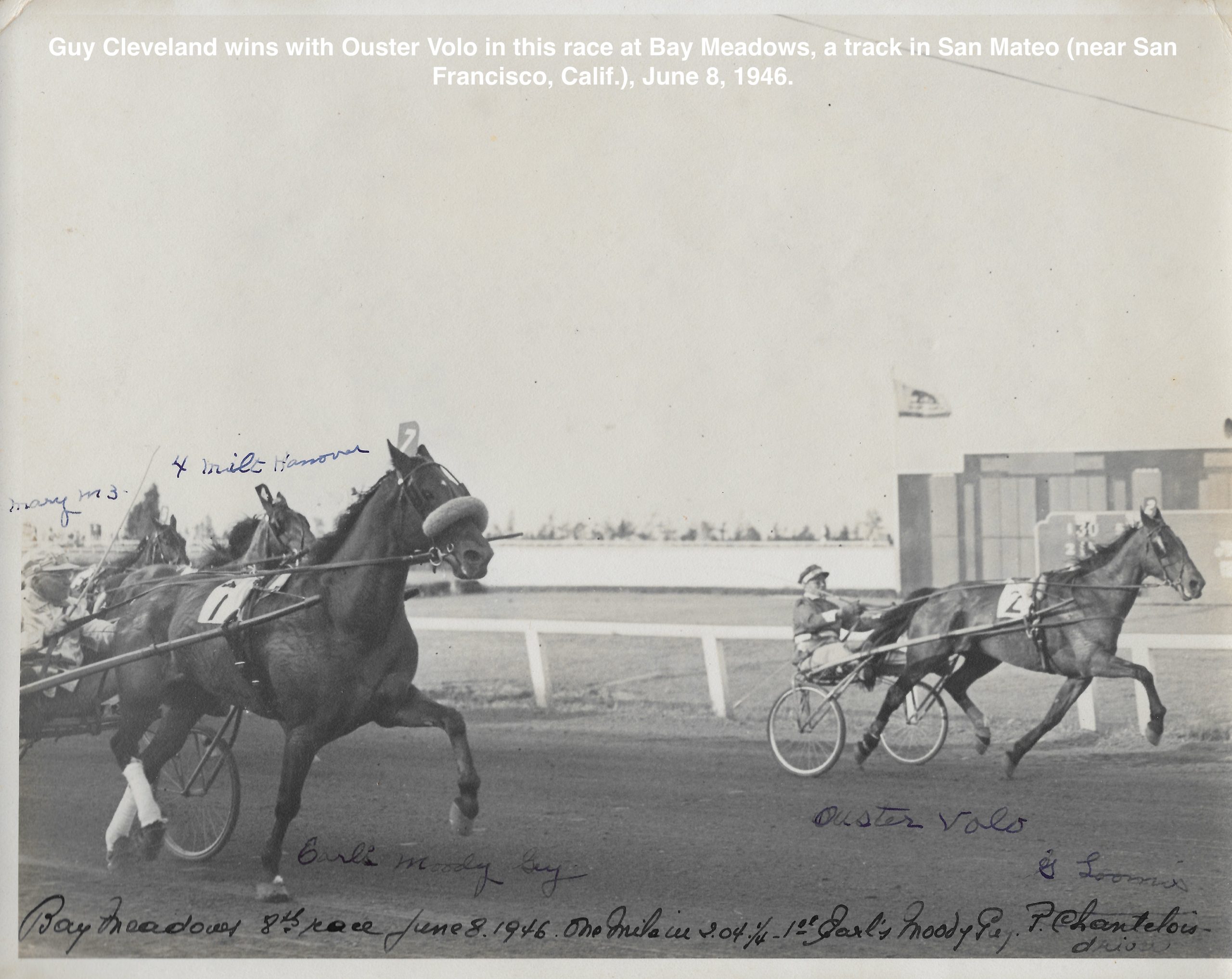
Ouster Volo was born in 1931 sired by Outsider out of a Peter Volo mare Dot Volo. As a yearling he was brought up by a well-known horse owner at the time, Henry Conklin. By January of 1933, the barely 2-year-old Ouster Volo appeared in a newspaper with Henry trying to sell a half interest in his colt as a future stallion prospect. He was turned over to Verne Schamahorn to be trained, and he had shades of talent in his early races, trotting a heat in 2:06 as a 3-year-old. These early years of his life were his least well documented but the most important in shaping who he was. Between 1933 and 1938 when Guy Cleveland was first documented to have acquired Ouster a lot had changed. The horse, once having a 50 percent share of him being sold in newspapers, was now a 7-year-old purchase by Guy for a bargain basement price of $55. The price was so low mainly thanks to already developing a reputation as a wild horse. Ouster Volo chased, bit, or kicked anyone who dared to go near him. No side of him was safe. The most horrific legend that surrounded him was that he was in the auction because he had killed someone.
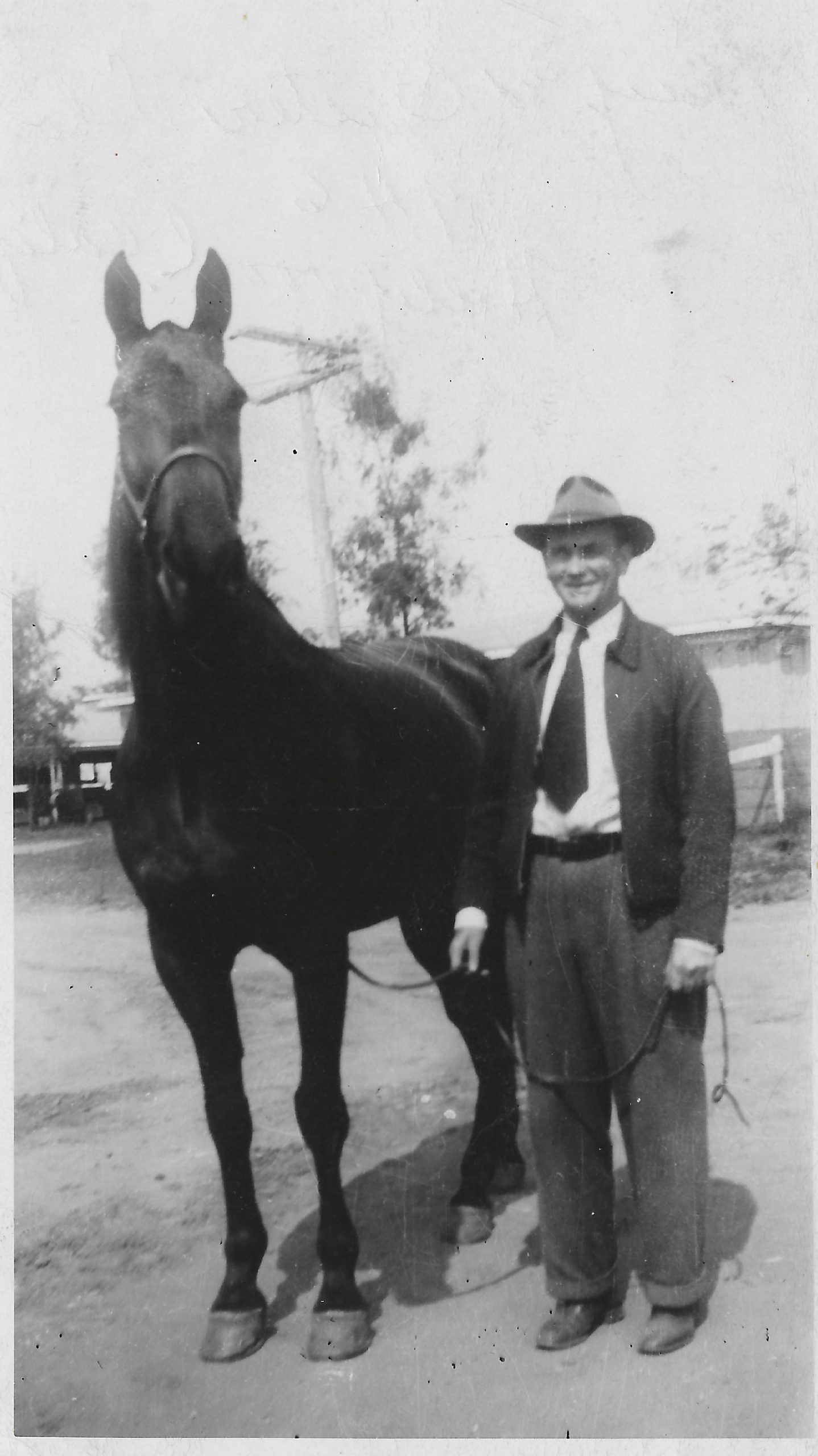
But Guy saw right through Ouster Volo. The original talent that was suggested before he ever raced was still there, but the angry horse needed a change. The training he had received as a youngster had left him scarred. The most glaring being a seething hatred of whips. If you used the whip on Ouster, you were not going to win a race. Cathy Hanks, Guy Cleveland’s Granddaughter, the same one who had been chased out by the long retired Ouster when reflecting on the star horse, believed it was nurture more than nature that made him who he was.
“I think the real reason that he was always so mean is that he was abused as a youngster.” said Cathy. “I know that in the Quarter Horse breeding industry, there are genes that are predominant in bloodlines that carry through from generation to generation, and I believe the same is true for all horse breeds that could make a horse have a difficult personality. But with Ouster, it was definitely because he had been abused. He had been whipped to pieces.”
Most in Guy’s position would see the only upside being that he wasn’t very expensive. But Guy had done this before, developing his own reputation of turning seemingly worthless horses around and making them sturdy money makers and class travelers. An example was another of Guy’s horses, a mare named B.B. When he got her for just $75, she was 12 years old and had gone lame at the White County Fair in Carmi, Ill. A year had gone by, and that $75 mare had won 9 of 10 races earning over $1,000 and once breaking a track record twice in a single day.
Ouster Volo would be gelded. No future Ouster’s to terrorize the tracks. He joined B.B and Guy’s crew of horses at his new home in Carmi in Southern Illinois. There, his rehabilitation began. To Guy he was no longer just going to be a racehorse. Guy put him to work on the farm. He wasn’t just pulling sulkies, but grain drills, and plows. He would be out in the fields under Guy’s kind but firm guidance. He wouldn’t do this alone, being frequently put between two mares to do the most arduous tasks. These mares forced him to work as a team member and gave him something he couldn’t get away from. Hard work in the fields did wonders mentally and physically. He now wasn’t just racing fit but farm strong. They also forged a good partnership.
But Guy learned how to work around the horse’s dislikes and get him to race happily. The two easiest ways to make Ouster Volo angry were to whip him or to restart a race. In those days, a starting truck was not used but instead a run up start. Horses lined up on their own and a starter would yell “Go” to commence the race. But getting horses to line up well enough for a fair start was no easy task and many false starts occurred. This would enrage Ouster Volo; he needed to go uninterrupted. If Ouster Volo was angry, he was not going to race well. This was a major reason that his results in races and heats sometimes varied greatly. But when he was calm, he was a steely racer. Guy pointed him in the right direction but also stayed out of Ouster Volo’s way, a relationship of strong direction but a gentle hand to heal a hurt soul.
In 1939, Guy’s first racing year with Ouster Volo, the horse earned him $2,349.86. That’s 42 times his paltry $55 auction price. It only continued, one year winning 20 times against competitors valued at up to $5,000, another year sweeping 13 of 15 races in a season. The great physical strength he always had was now concentrated on the racetrack, making him effective and ultra consistent as long as there weren’t too many false starts.
Ouster also possessed a unique ability not seen much today. He was a double gaited horse, able to pace and trot. While he was a far more accomplished trotter, the ability to pull both off took him to new heights. Multiple years earning thousands as both a trotter and a pacer separately. He could stop at almost a dozen fairs and win at least once at all of them.
Purses were low and racing was restricted as racetracks and fairgrounds were being converted into training bases during World War II. But Ouster Volo kept on earning thousands. In the war’s prime years, he would earn over $18,000 between 1942-1945. Luckily for him his longevity made it so he could outlast the war.
As soon as World War II ended the now 15-year-old Ouster Volo was given two of his greatest opportunities as a racehorse. His first big shot was the west, Santa Anita Park, a place normally where the best Thoroughbreds like Seabiscuit stepped foot. But in 1946 a new Harness meet was proposed immediately following the track’s Thoroughbred meet. The Western Harness Association helped organize a huge meet with giant purses set for five weeks at the great race place and then to travel up north to Bay Meadows for another five weeks. Over 800 horses, mostly by train car, migrated to California to take part in this never before seen meet, including Ouster Volo.
Guy and Ouster Volo would race on opening day to a crowd of over 10,000 in one of the smaller races on the card, a conditioned trot. But even this smaller race had a prize of $1,000. That would take multiple outings in fair races to equal. His first race saw him come in fifth but in less than two weeks he would reach the winner’s circle proving that he belonged. In over five weeks he was able to win three times from 10 races before a date with the biggest race he ever participated in.
To end what was dubbed “the meet of the century” on a high note, two $50,000 races were created. The Golden West Trot and Golden West Pace, some of the largest purses ever seen for an individual race in harness history. Ouster Volo entered the trot in an outrageous field of 24 horses all hungry for the lion’s share of this mile and a quarter race. It wasn’t meant to be for Ouster Volo, and he was shuffled back to 16th and Kaola claimed the great prize. But the meet proved he belonged with the best and so his journey to the west was not over. He had three outs at Bay Meadows winning one but ending with a last place finish.
Returning from the west, Ouster Volo’s big year wasn’t over. His next challenger would not be from America but a neighbor from the north, the Canadian horse Tracey Hanover, a true traveler who competed all over her home country and in the United States. Like Ouster Volo she was an experienced dual gaited horse. The purse would be $1,000 for each race, one over each gait staged over The Red Mile.
Match one would be trotting and be set at three separate distances. Heat one for the trot was one mile and taken by Ouster Volo. But as the distance was increased Tracey Hanover took heat two over a mile and an eighth. But by the time the heat was over it was too late to race again so the tie breaker was staged the following day.
In this rematch the race was settled with Ouster Volo winning the tie breaker in the mile and sixteenth race, proving the best at the trot. But the following week in the pace, Tracey Hanover won the first heat, and the race was declared over.
Ouster Volo seemed to have had enough for 1946. By the year’s conclusion he had earned a personal record of $10,364.36 earnings for trotting and $1,535.63 for pacing. Combined he had amassed $11,899.99. Ouster Volo continued to race until the end of the decade, amassing a few more victories including one at a unique distance of 9/16 miles at Maywood Park, adding another feather in his cap, being able to win at a mile trotting or pacing, but also being able to race shorter or longer. His last race occurred at Albion Park in 1949 where he won the first heat but lost the second.
After this at age 18 and with no further records found, Ouster Volo was assumed retired. He didn’t have one standout big race to his name. No Triple Crowns, no Breeders Crowns, but what he did have was a decade and a half of racing at any track, any distance, any gait. Plowed the fields in the morning and raced in the evening. Earning an appropriate retirement for such a workhorse getting to live out his days with the man who brought the best out of him until his 30’s. He was worthy of praise but from a safe distance, for one must heed the warning that this horse was not safe to be around.
by Nathan Klein, Race Marketing Intern at Horseshoe Indianapolis